
The Collector was never intended to become a collection.
It all started during a conversation at the home of my good friend Francisco Bernaldo, a passionate watch collector and probably one of the largest Swatch collectors in the world, with more than 20,000 pieces, plus an extraordinary collection of watches from both well-known and lesser-known brands.
Francisco has been collecting, studying and enjoying watches for years. He knows them extraordinarily well.
One day he asked me a question that seemed simple:
“Would you be able to create a new line of watches unlike anything we’ve seen so far?”
I was very clear about what the starting point should be.
A classic 39mm case, elegant and timeless, with proportions that will work just as well on a man’s wrist as on a woman’s.
But within that classical architecture he wanted the exact opposite of the conventional.
I wanted to Color. Joy. Optimism.
I wanted a watch that would make you smile every time you looked at your wrist.
For me, the real challenge was not to design just another watch.
It consisted of creating something capable of surprising someone who had already seen, had and studied thousands of them.
So I spent a lot of time thinking about one question:
What kind of watch can you create for someone who already has pretty much everything?
The answer ended up taking me back to the beginning of everything.
To the sphere.
To the different visual languages that watchmakers have used over generations to represent something as universal as time.
And that led me to another idea:
What if these watches could also tell a small part of the history of watchmaking?
I decided to create five different watch faces, each inspired by a different visual language that emerged throughout the evolution of the watch face:
ROMAN. NUMBERS. CALIFORNIA. INDEX. DOTS.
Together they would form a small journey through the history of watchmaking.
Not as an academic lesson, but as an invitation to watch lovers to discover how our way of visually interpreting and reading time has evolved over the years.
Then came the funniest part.
Take that story and break some of its rules.
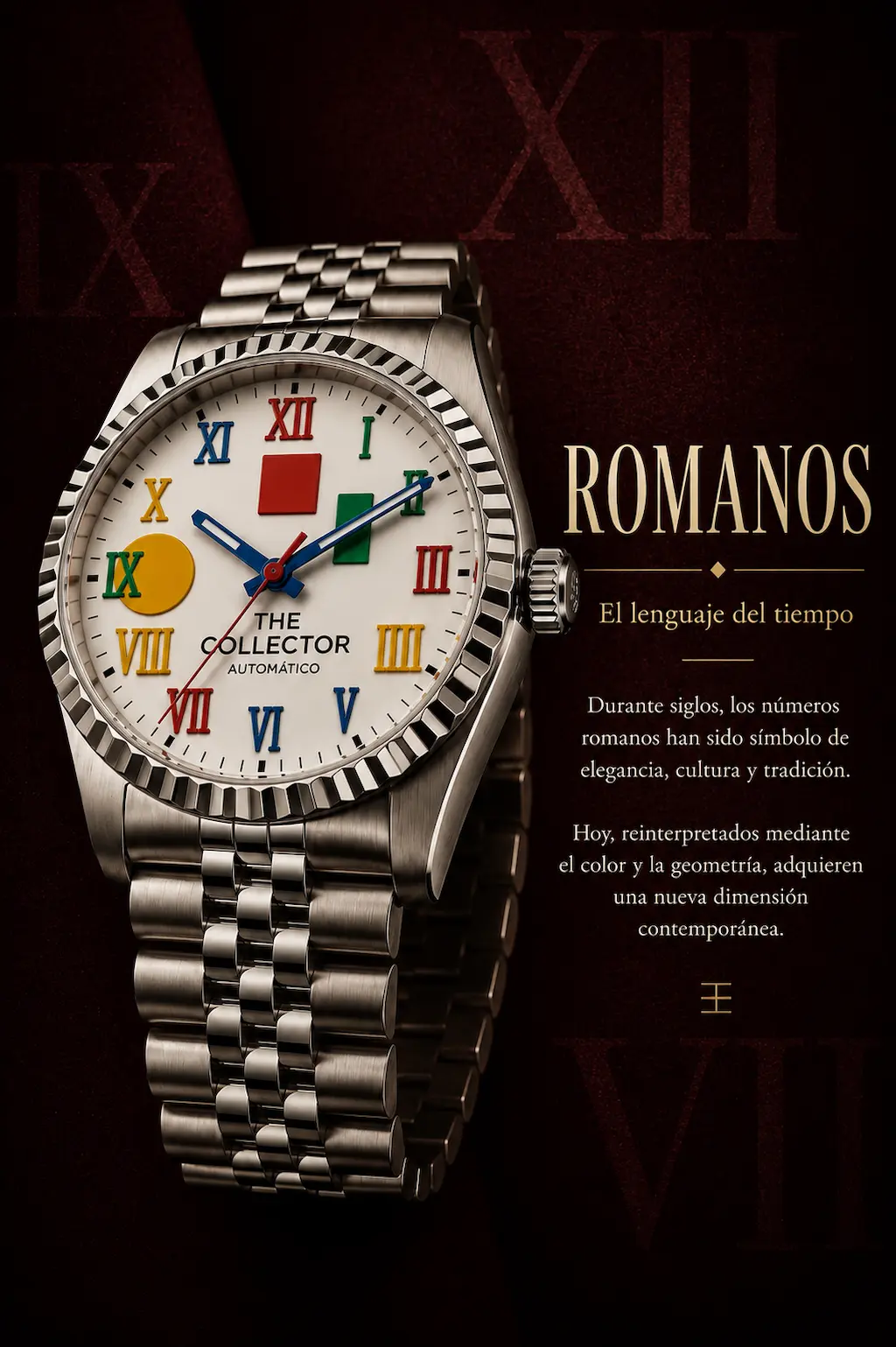
The Roman numerals were filled with color.
The Arabic numerals took on a playful character.
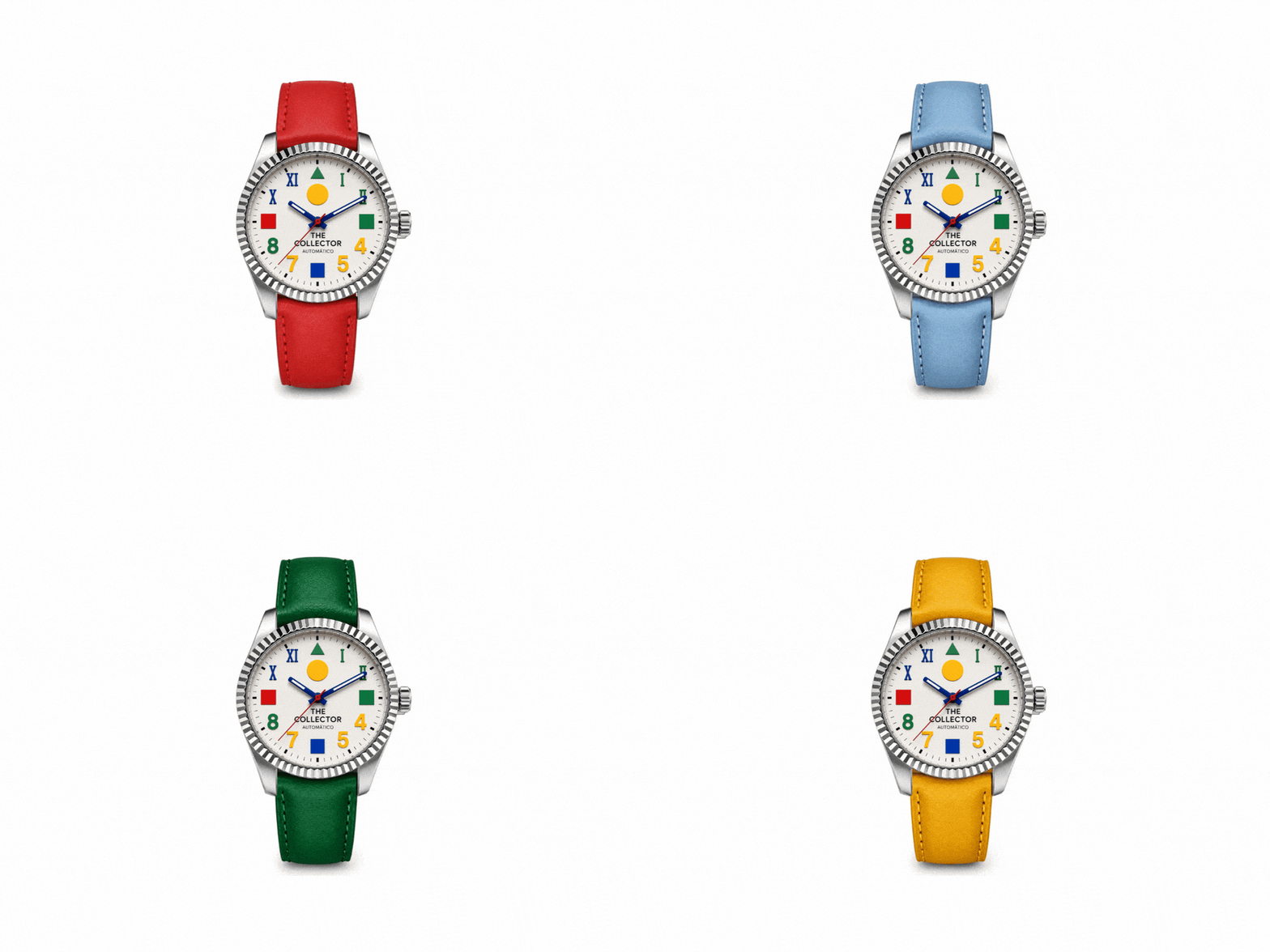
Traditional indices gave way to unexpected combinations of circles, squares, and triangles.
Red, blue, yellow and green entered a world traditionally dominated by sobriety and conventions.
The idea was not to reject the watchmaking tradition.
It was playing with her.
To take recognizable elements from the history of the spheres and reinterpret them through the spirit that Francis had called for from the beginning:
Color, joy and optimism.
One idea led to another.
One sphere became two.
Then in three.
And finally, five completely different personalities emerged from the same watch.
They all share the same 39mm case, mechanical heart and construction.
But each speaks a completely different visual language.
ROMAN. Tradition reinterpreted through colour.
NUMBERS. The universal language of legibility, taken to a more playful terrain.
CALIFORNIA. Two historical languages that are in the same sphere.
INDEX. Simplicity, order and modernity.
DOTS. Time reduced to its most abstract geometric expression.
FIVE CHAPTERS. FIVE VISUAL LANGUAGES. A COLLECTION.
And when it came time to name the project, there could really only be one.
The person who inspired him had dedicated a good part of his life to collecting watches.
And now, unexpectedly, he himself had inspired a collection.
THE COLLECTOR
Created for a collector.
Made for collectors all over the world.


Five personalities. The same mechanical base.
All the watches in The Collector collection share the same case, construction and mechanical specifications. What changes is the dial: five different interpretations of time built on the same mechanical watch.
LIMITED EDITION To 250 units per model.
CASE AND DIMENSIONS
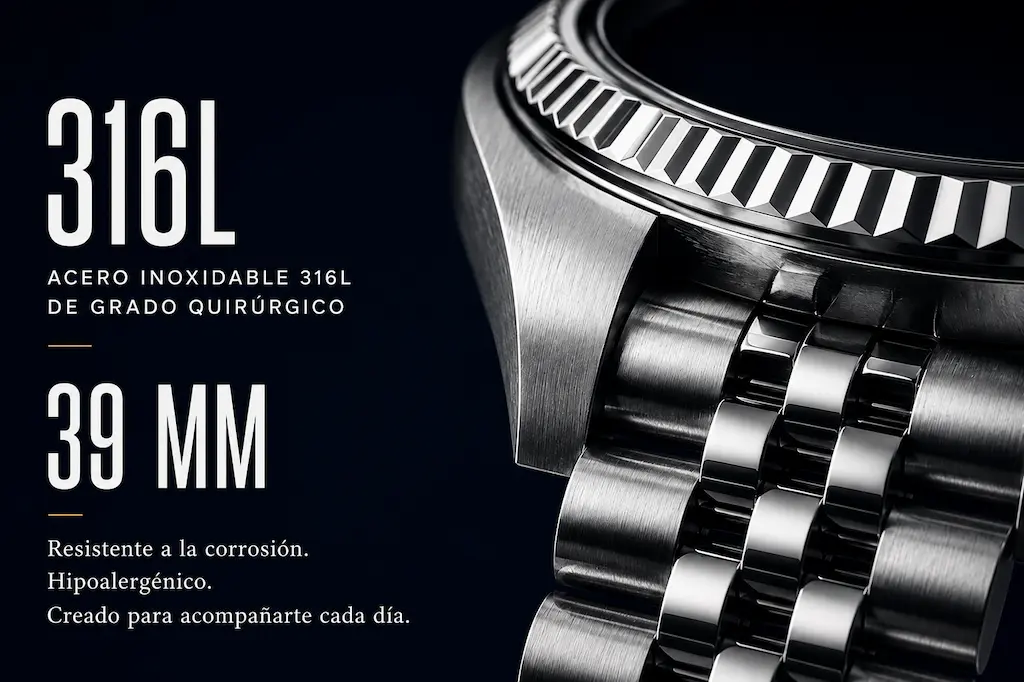
• Case diameter: 39 mm
• Thickness: 11.90 mm
• Distance between handles: 46 mm
• Width between handles: 20 mm
• Weight: 110 g
• 316L stainless steel case
• Fluted bezel
• Screw-down crown
MOVEMENT
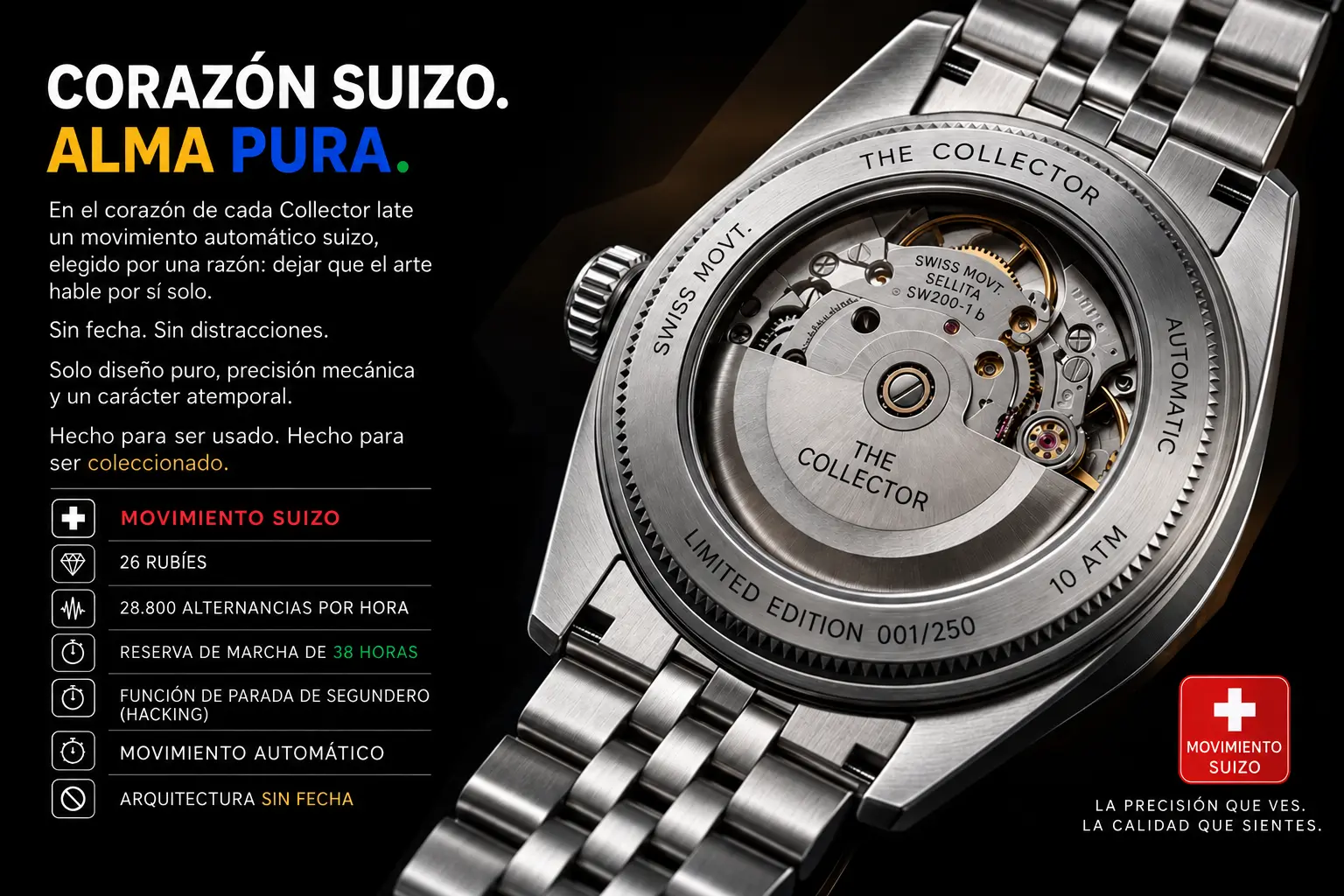
• Sellita SW200-1b
• Swiss automatic mechanical movement
• 26 jewels
• 28,800 vibrations per hour / 4 Hz
• 41-hour power reserve
GLASS AND CASEBACK
• Front sapphire crystal
• Exposed caseback
• Mineral crystal on the caseback
WATER RESISTANCE
• 10 ATM / 100 meters
DIAL
• Five different layouts: Numbers, Roman, California, Dots, and Index
• Three-dimensional elements applied to the dial
• Specific combinations of numbers, indexes, geometric shapes and color for each model
BRACELET
• Stainless steel bracelet
• Folding clasp with push-buttons
• Width between handles: 20 mm
WARRANTY
• 10-year Colomer & Sons warranty
Designed in Spain. Powered by Swiss mechanics. Created for collectors.

The Collector isn’t just a concept. It’s a fully functional mechanical watch.
The design and development phase of The Collector has already progressed to the creation of functional prototypes.
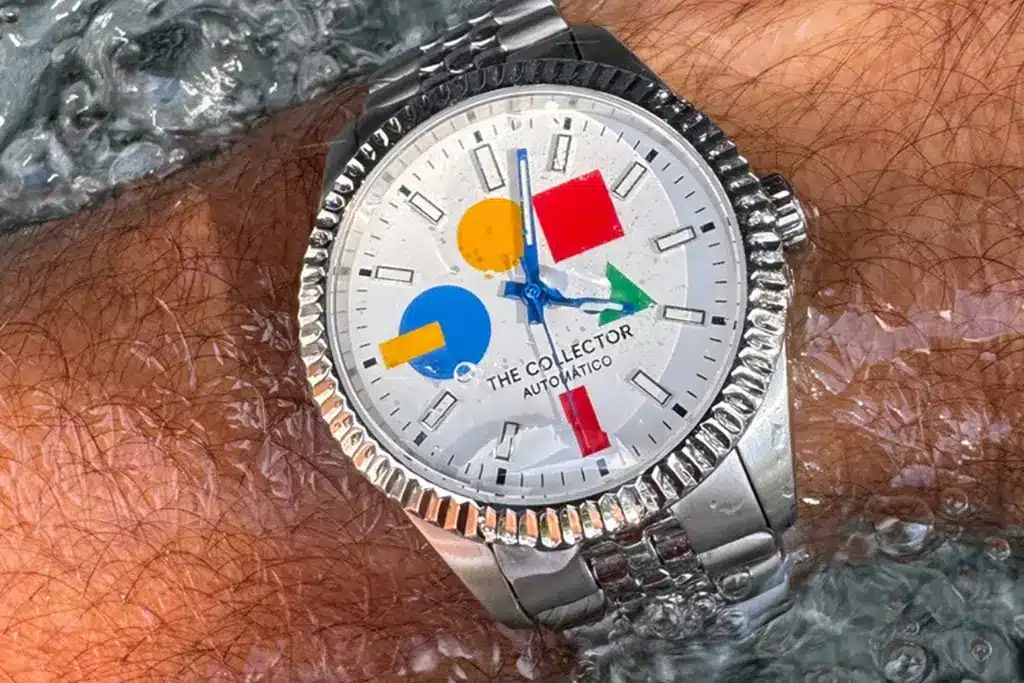
Our prototypes allow us to evaluate the watch in real-world conditions, including the proportions of its 39 mm case, its presence on the wrist, bracelet and clasp, the screw-down crown, the dial construction and the operation of the Sellita SW200-1b automatic movement.
The video below shows one of our real functional prototypes, manipulated and put into operation by our team in a single continuous, unedited shot.
Here you can see the movement working in real time, the actuation of the hands by the crown, the threaded crown mechanism, the bracelet and the clasp, as well as the watch from different angles.
What you see here is a real, fully functional prototype, not a render.
The goal of the Kickstarter campaign is not to develop a watch from scratch. The design and prototyping phases are now complete. The campaign will allow us to bring The Collector into production and manufacture the watches for our backers.
DEVELOPMENT STATUS AND PRODUCTION SCHEDULE
The Collector is already well advanced with respect to the conceptual phase.
The design, engineering and prototyping phases are complete. We have developed functional prototypes that have allowed us to evaluate the case, dials, bracelet, movement integration, proportions and overall construction of the watch before moving into series production.
Our manufacturing partners and major components have already been selected. Once the Kickstarter campaign is successfully completed, we will move directly into the production process.
WHAT ARE WE AT
✓ Finished collection concept and design
✓ Five finished dial designs
✓ Case development and finished bracelet
✓ Selected and tested movement
✓ Manufactured functional prototypes
✓ Finished prototype evaluation
✓ Selected manufacturing partners
✓ Development of the finished packaging
PRODUCTION SCHEDULE
SEPTEMBER 2026 — Kickstarter Campaign
The Collector launches on Kickstarter. Once the campaign is over, the final production quantities will be confirmed based on the models chosen by our backers.
OCTOBER 2026 — Production preparation
Final quantities of Numbers, Roman, California, Dots and Index will be confirmed. Sellita SW200-1b components, dials, cases, bracelets and movements will enter the production and procurement process.
NOVEMBER–DECEMBER 2026 — Manufacturing, assembly and quality control
The components will be manufactured and inspected prior to assembly. The watches will then be individually assembled and checked as part of our quality control process.
JANUARY 2027 — Final Inspection, Packaging Shipping
The finished watches will undergo a final inspection and final testing before being packaged and prepared for shipment.
We aim to start shipping The Collector watches to Kickstarter backers in January 2027.
FROM WATCHES TO THE WRIST
Before the wristwatch, there were already Roman numerals.
For centuries, Roman numerals were one of the most recognizable ways of representing time in watchmaking, present on watches and pocket watches long before the watch reached the wrist.
In the early 20th century, this classical language made the leap to the then-emerging wristwatch. In 1904, Louis Cartier created the Santos for aviator Alberto Santos-Dumont, one of the first wristwatches and an enduring example of the use of Roman numerals on the wrist.
The Collector Roman reinterprets this historical language through color, geometry and a contemporary look.
THE REAL FUNCTIONAL PROTOTYPE
Below we show the real working prototype of ROMAN used during the development of The Collector.
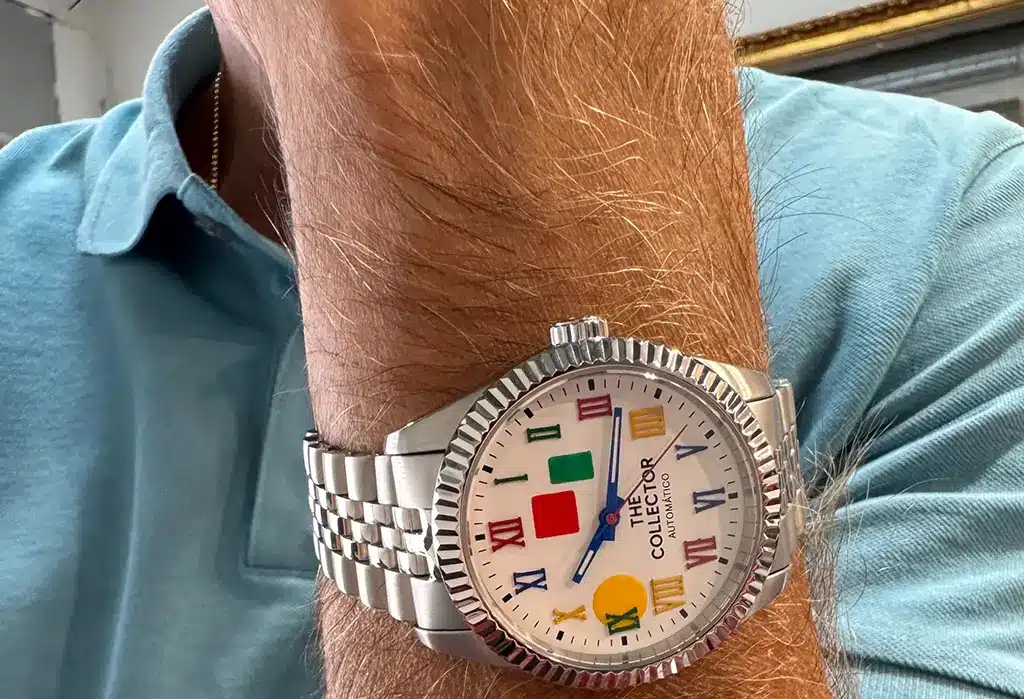
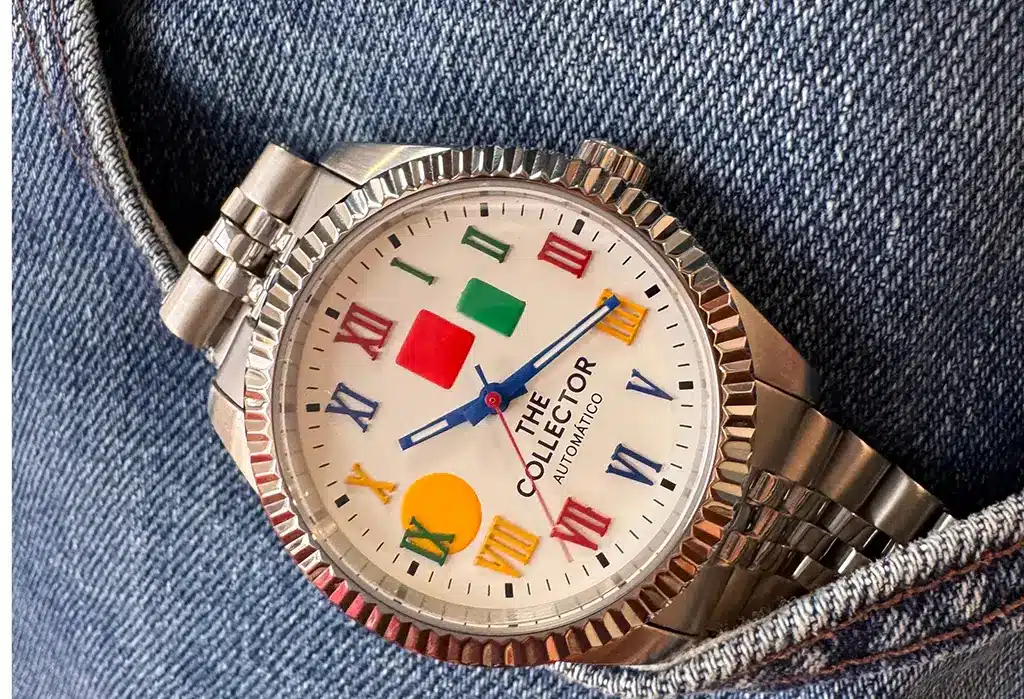
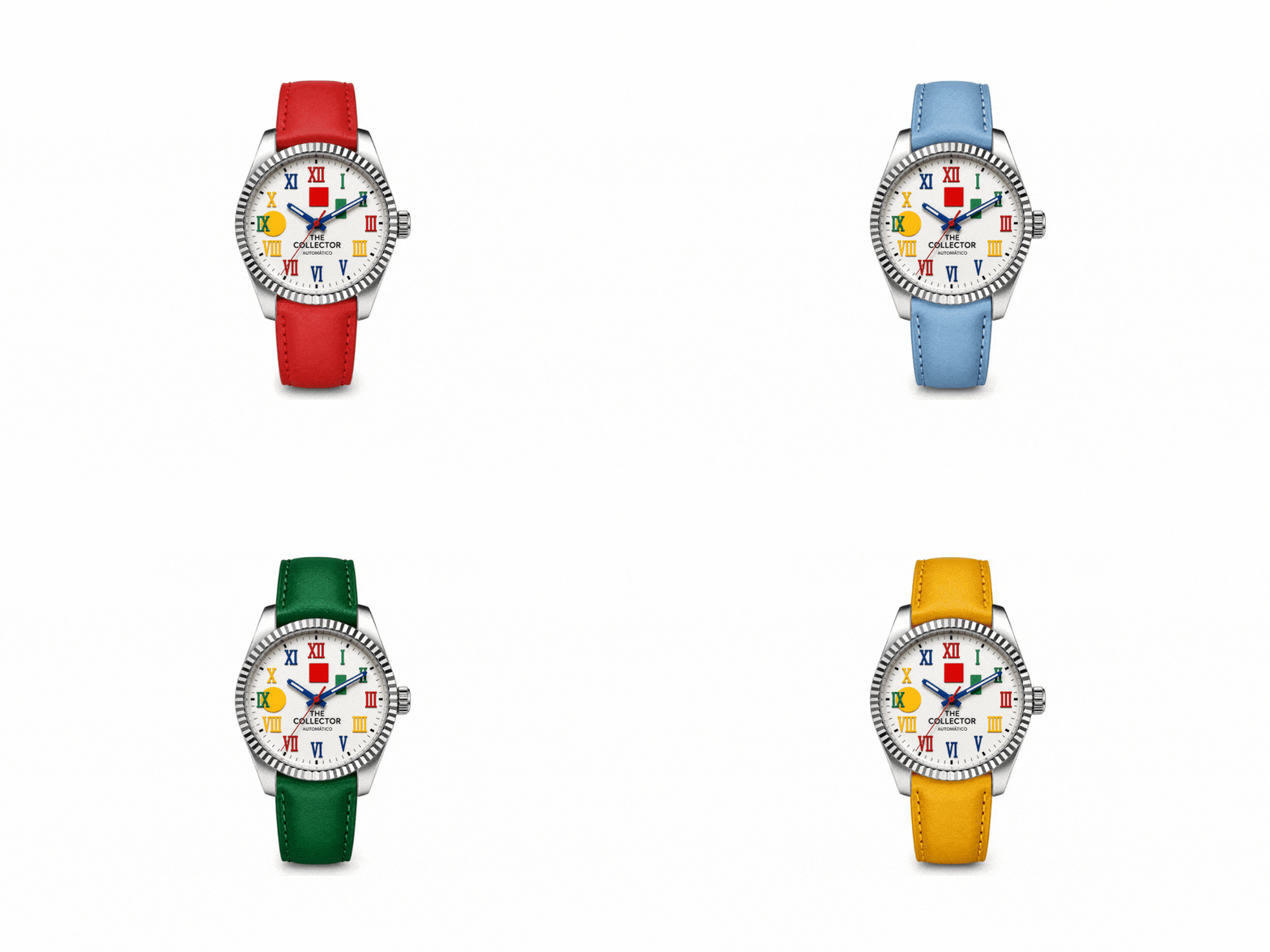
WHEN READING THE TIME JUST GOT EASIER
As watches became more practical, their dials began to change.
Roman numerals had dominated dials for generations, but by the end of the 19th century new dial-making techniques contributed to Arabic numerals becoming more common.
Its main advantage was simple: readability.
When watches moved from the pocket to the wrist in the early 20th century, large Arabic numerals took on particular importance. During World War I, so-called trench clocks frequently used large, highly visible numerals, designed to be able to tell the time at a glance.
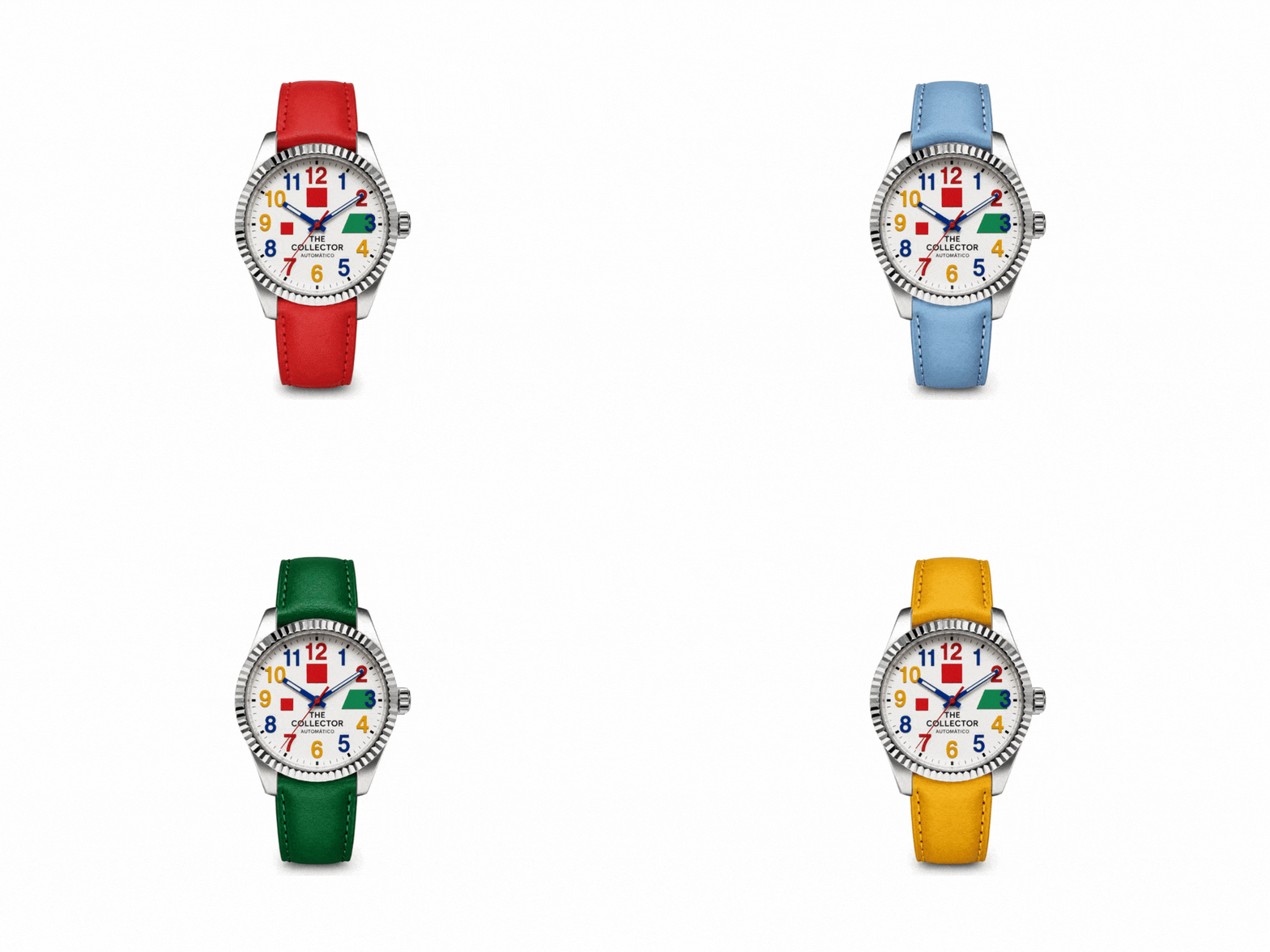
The Collector Numbers takes that clarity-based language and transforms it through color, scale, and contemporary geometry.
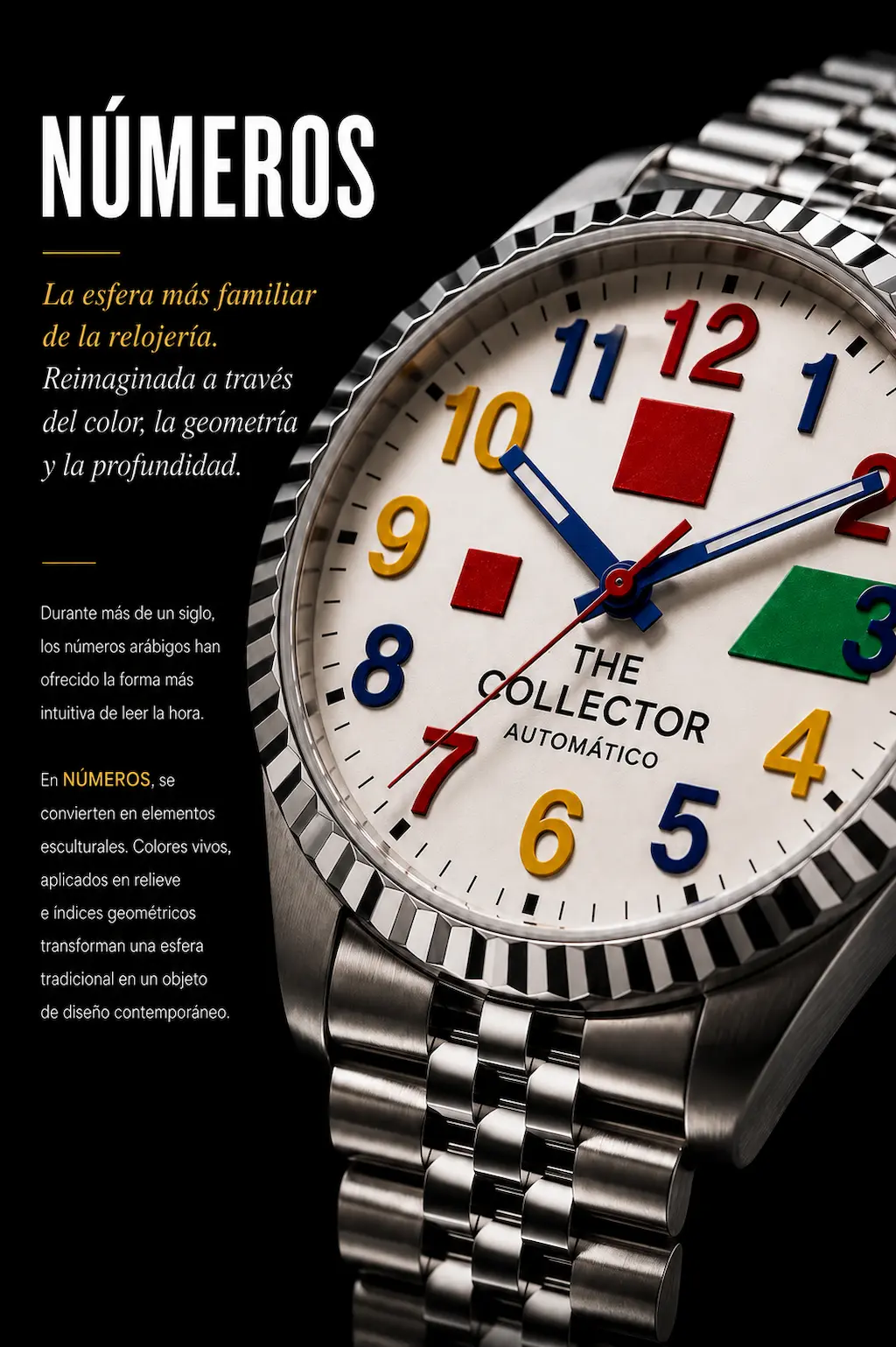
THE REAL FUNCTIONAL PROTOTYPE
Below is the actual working prototype of NUMBERS used during the development of The Collector.
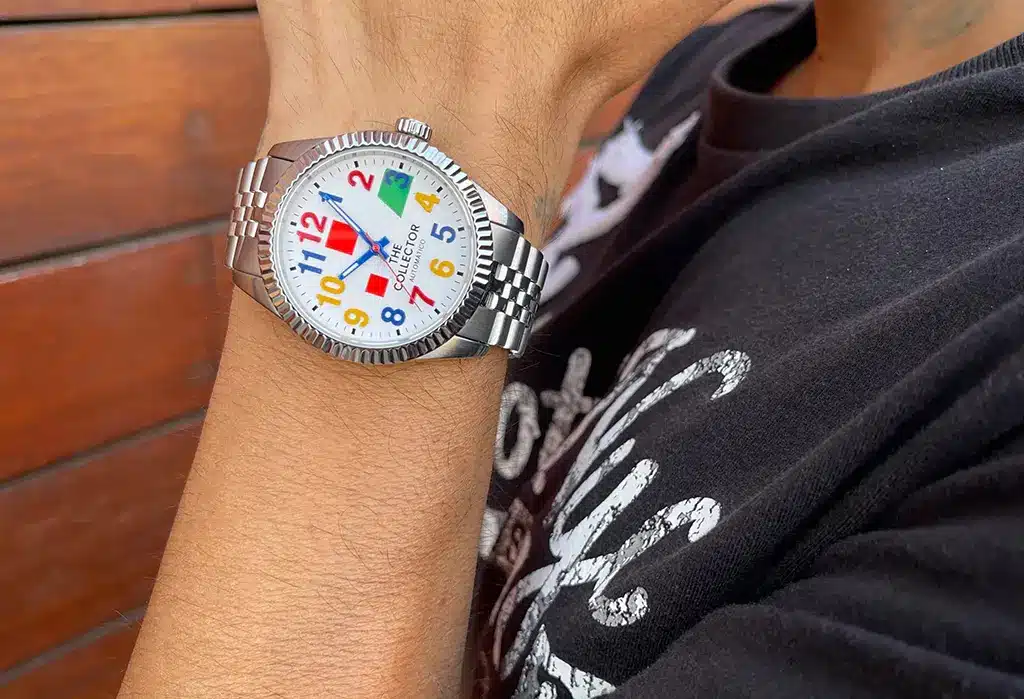
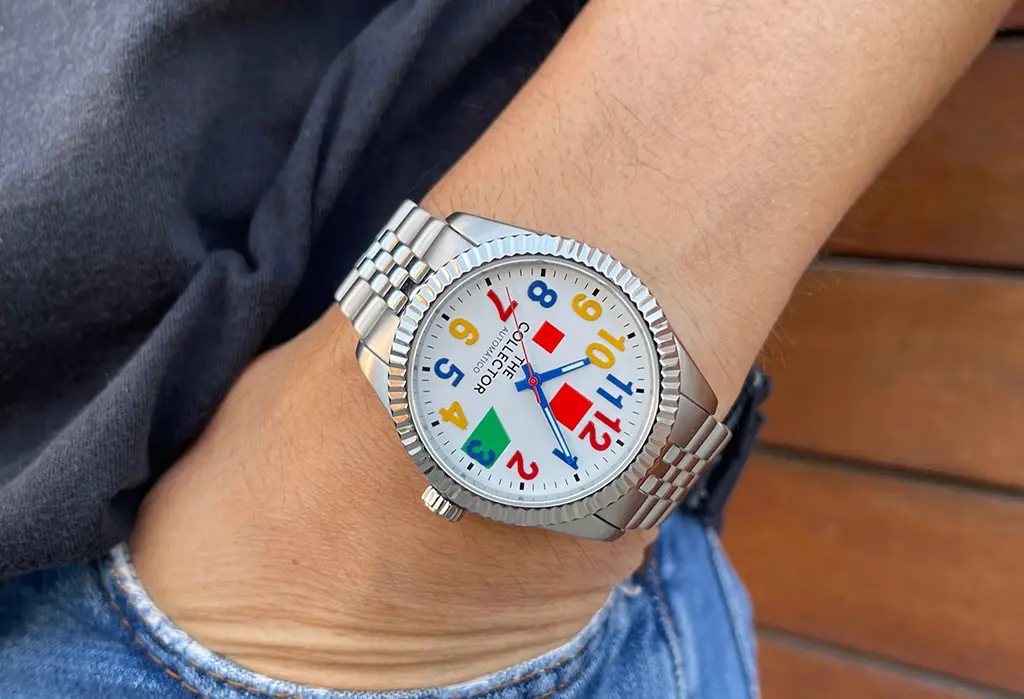
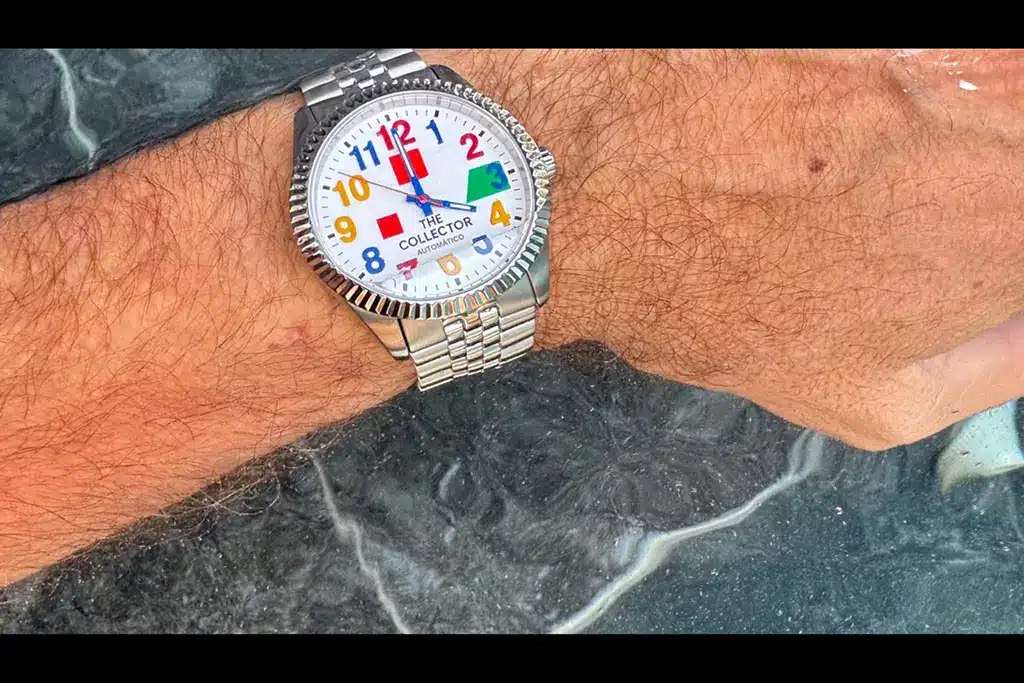


WHEN TWO LANGUAGES BECAME ONE
What happens when watchmaking breaks its own rules?
In 1941, Rolex filed a patent for a rare dial that combined Roman numerals, Arabic numerals, and geometric hour markers in a single design.
Later known as the “Error-Proof” dial, the contrast between its different visual elements created a characteristic and highly legible way of reading the time. This style would also appear on historic military watches during the 1940s.
Interestingly, the name “California dial” came much later, and it began to be associated with this design decades after its creation.
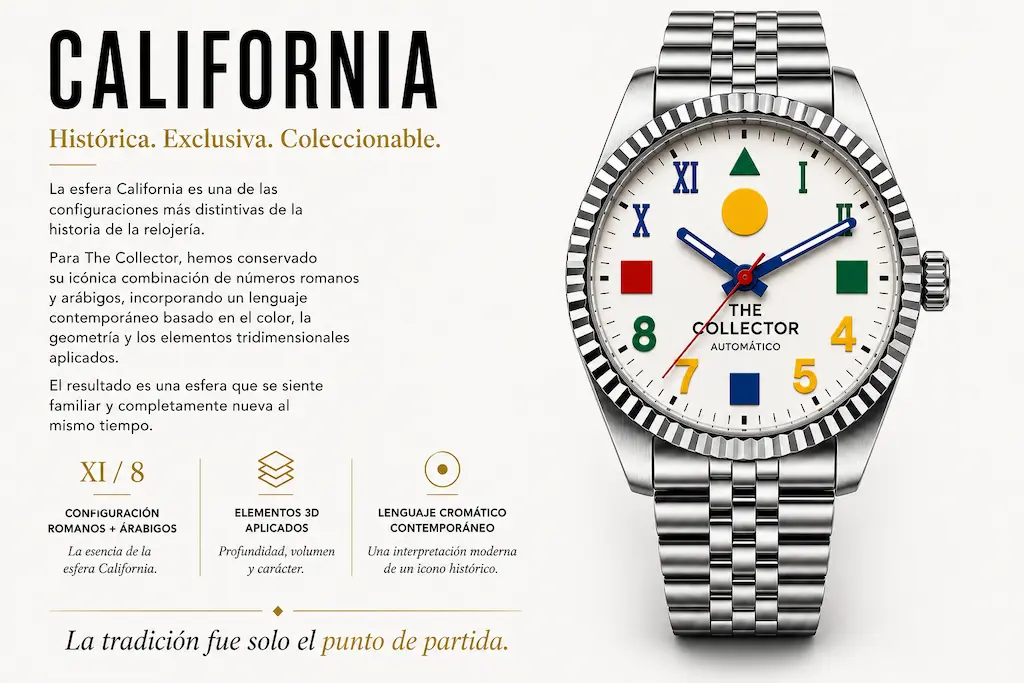
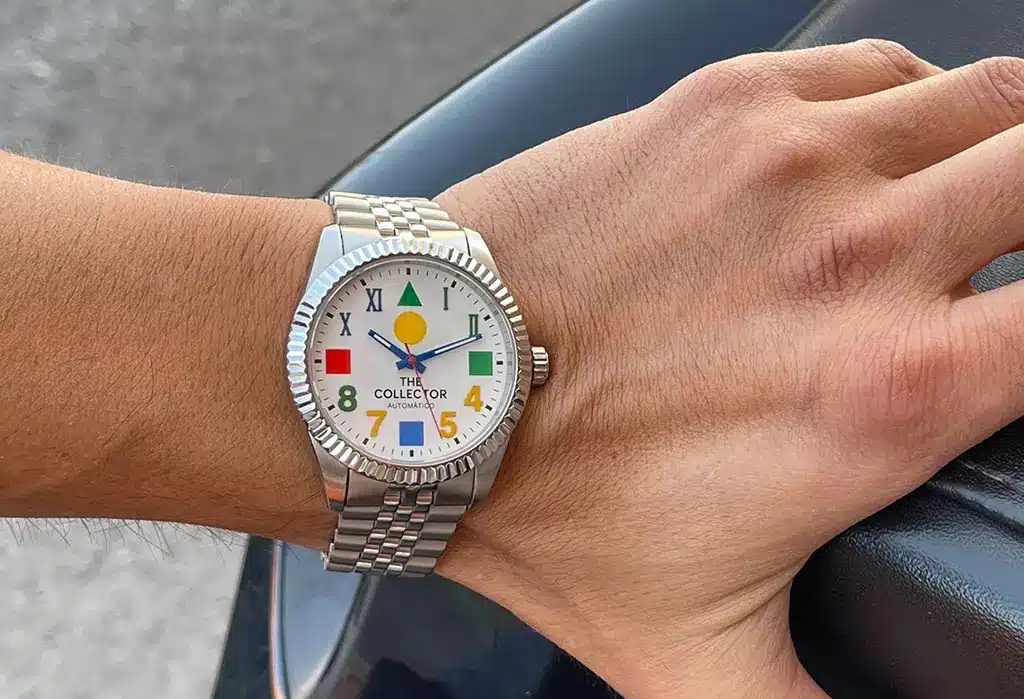
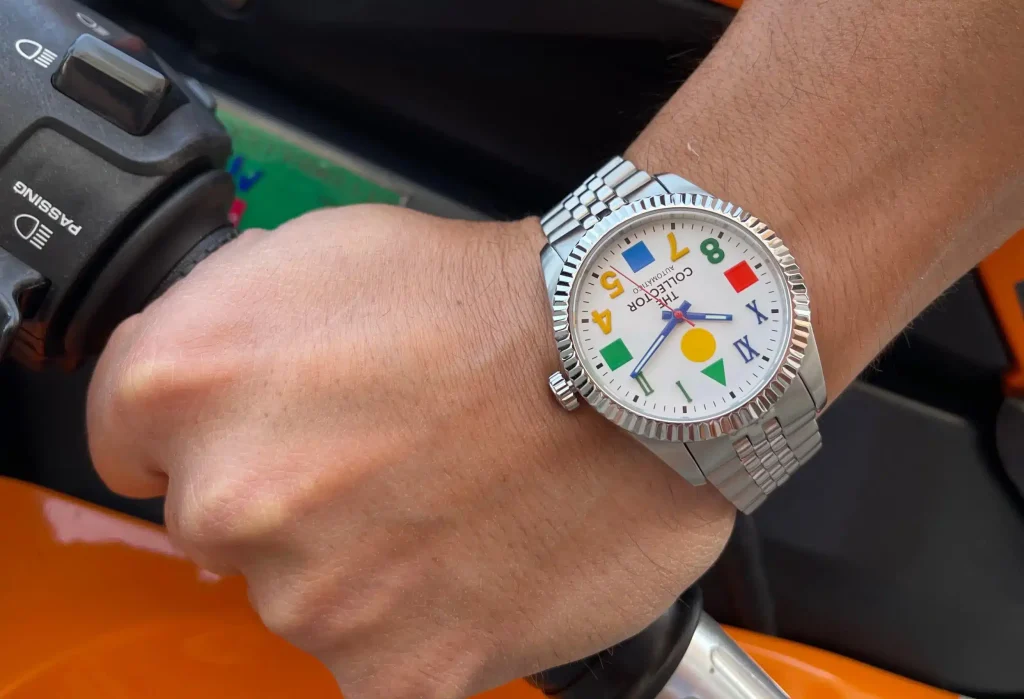
The Collector California celebrates that same idea: different visual languages coming together to create something unexpected.
THE REAL FUNCTIONAL PROTOTYPE
Below is the actual working prototype of CALIFORNIA used during the development of The Collector.


LESS BECAME MORE
What happens when the numbers disappear from the dial?
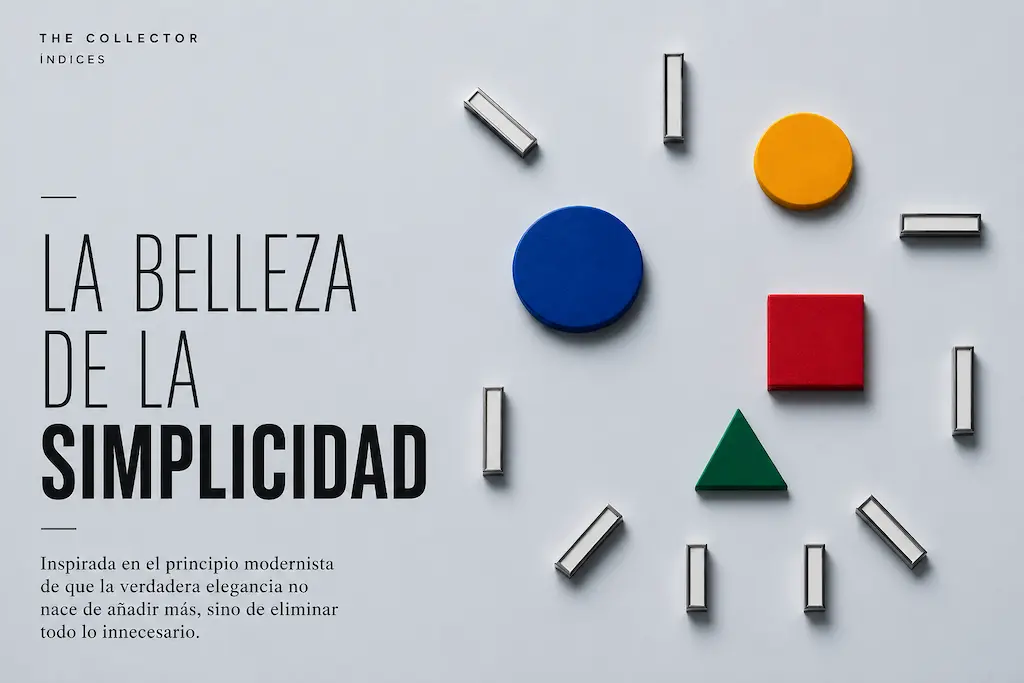
In the mid-20th century, watch design began to evolve towards cleaner and increasingly modern shapes. Applied hour markers came into greater prominence during the 1950s, while simple straight and baton indexes were strongly established during the 1960s.
By eliminating numbers, watchmakers discovered that a dial could be simplified without losing its ability to indicate time. The hour index itself became both function and design.
This minimalist language would eventually become one of the most enduring codes of modern watchmaking.
The Collector Index takes this idea of simplicity and brings a new personality to it through proportions, color, and three-dimensional shapes.
THE REAL FUNCTIONAL PROTOTYPE
Below is the actual working prototype of INDEX used during the development of The Collector.
WHEN GEOMETRY BECAME TIME
What happens when the traditional language of the sphere disappears completely?
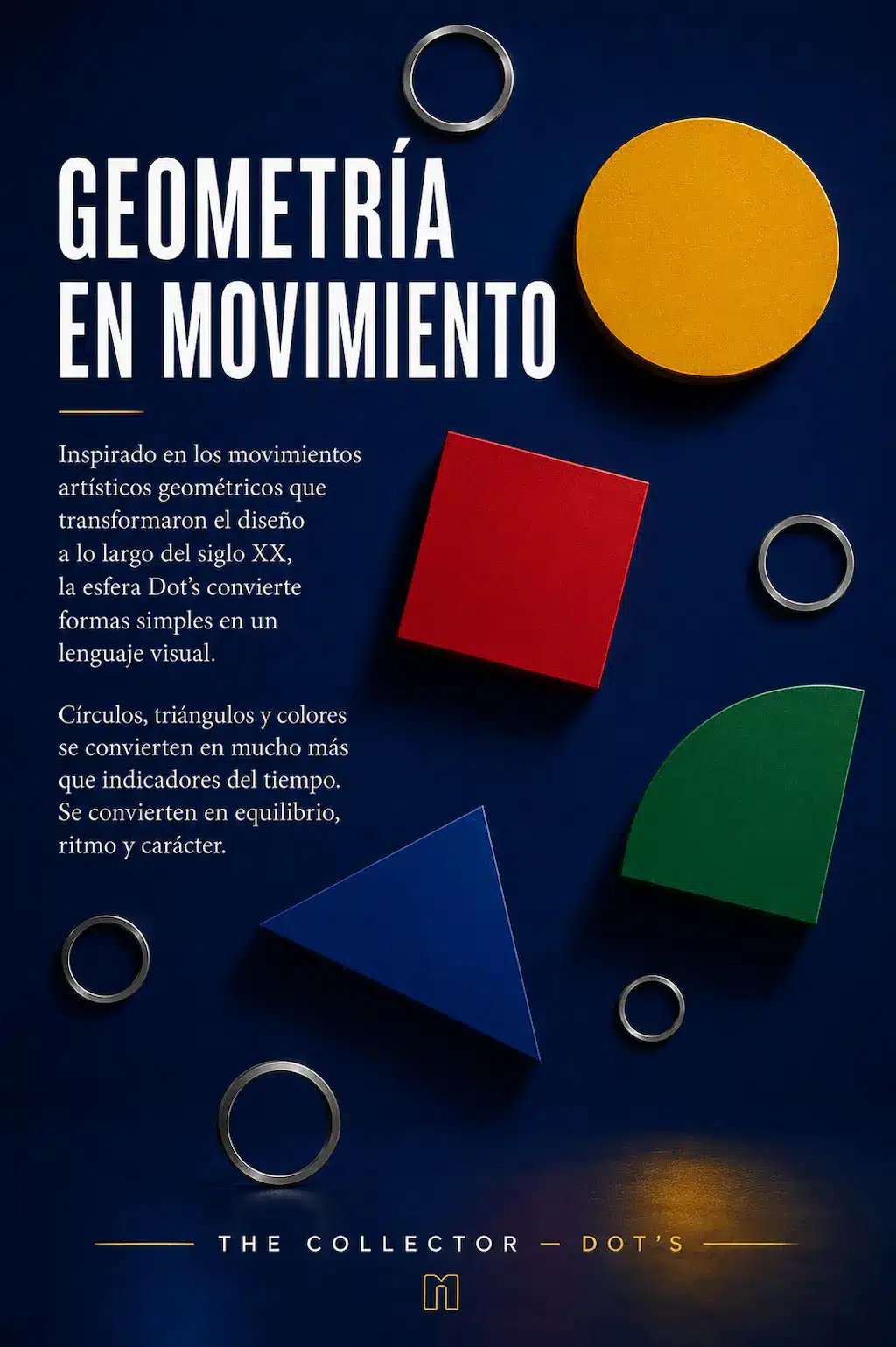
During the 20th century, modernist design progressively transformed the way watches communicated time. Influenced by movements such as the Bauhaus, designers explored simplicity, proportions, and elementary geometric shapes.
By mid-century, designers such as Max Bill brought this philosophy directly to watchmaking, reducing the dial to its essential visual elements.
The Collector Dots takes this evolution a step further.
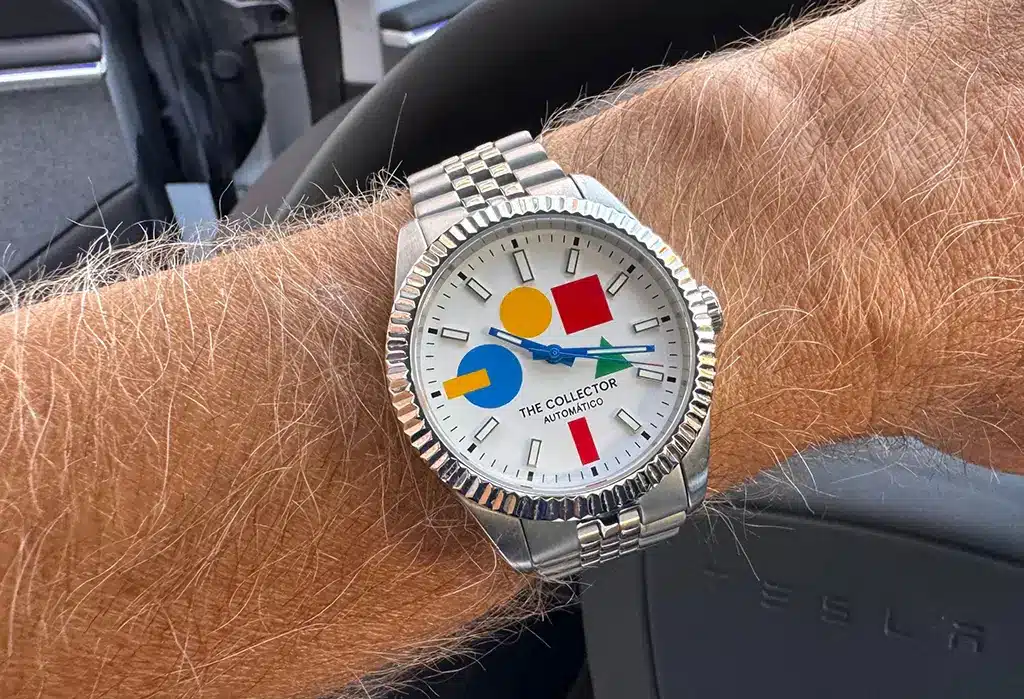
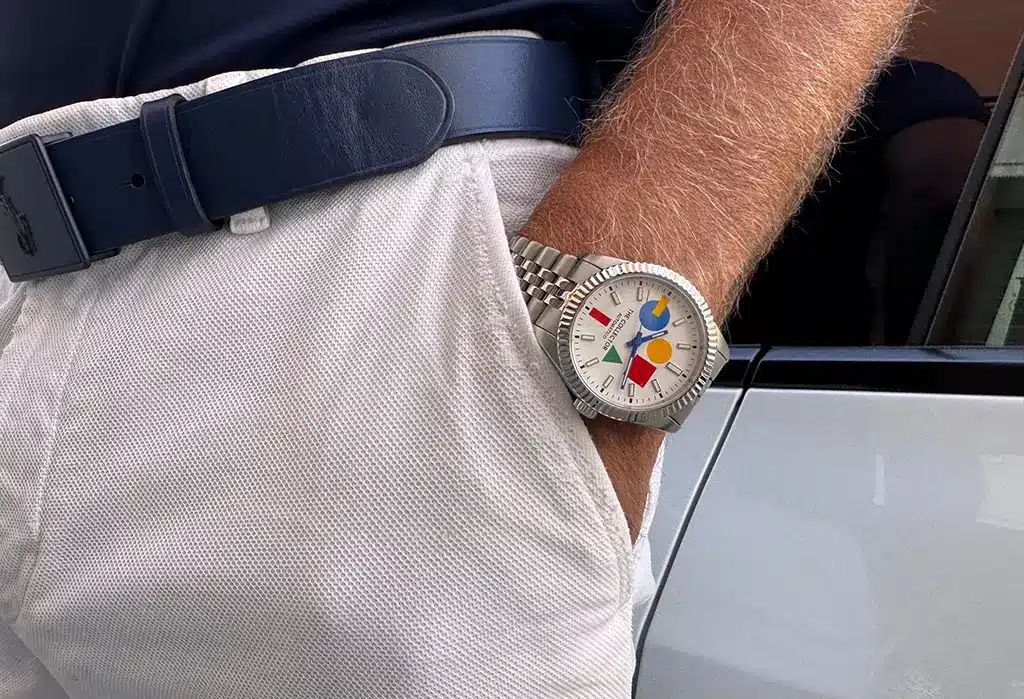
Numbers disappear. Traditional indices disappear. Circles, squares, triangles and colors become the language through which time is read.
Here, geometry becomes time.
THE REAL FUNCTIONAL PROTOTYPE
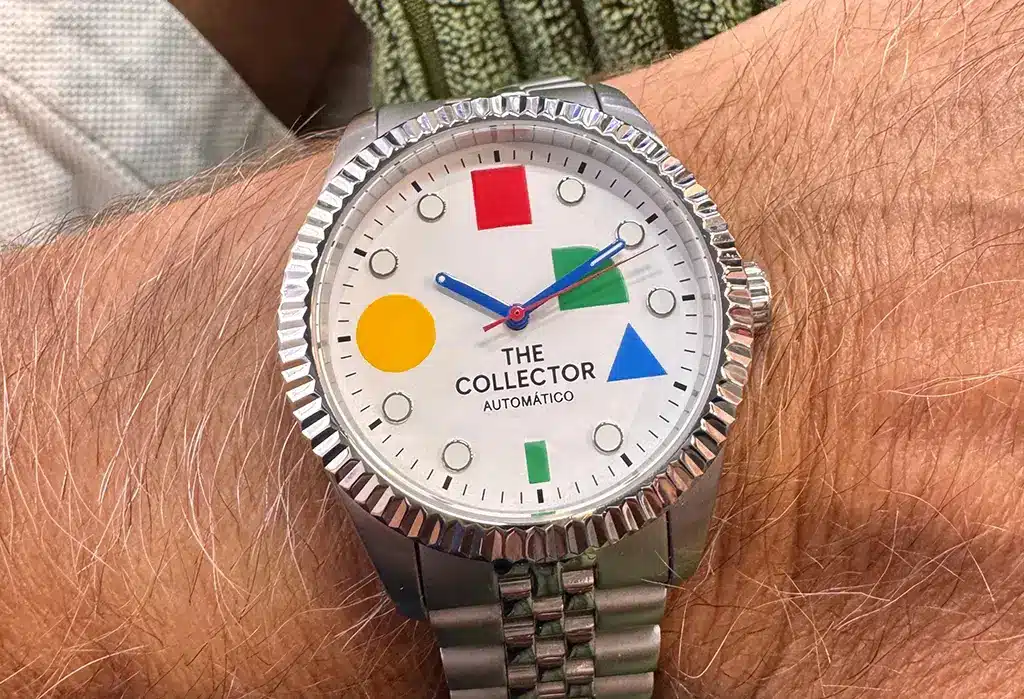
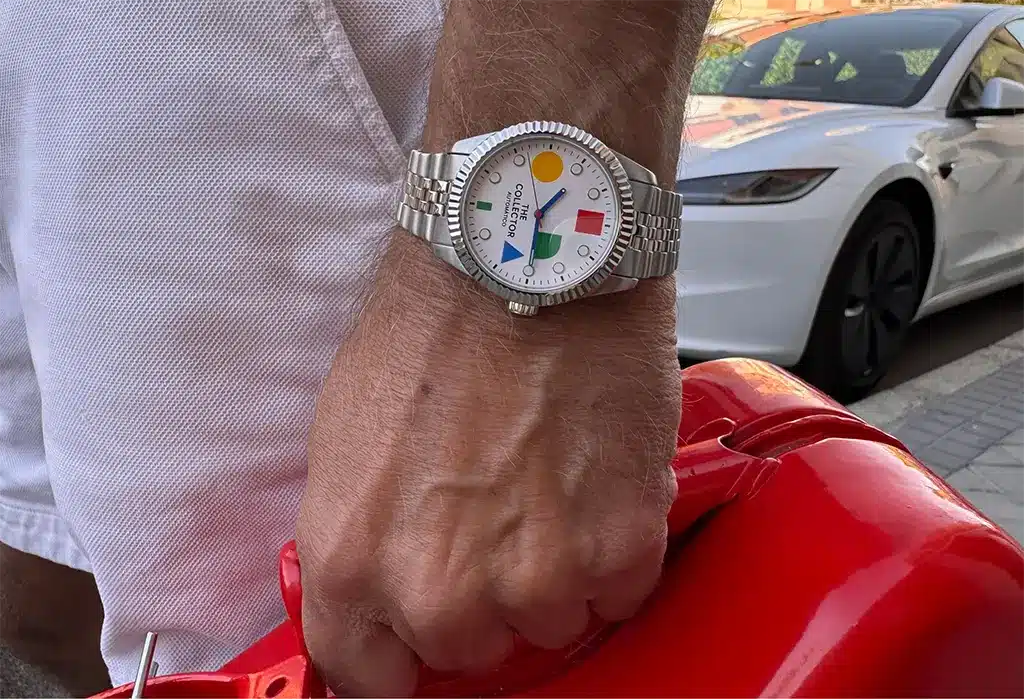
Below is the actual working prototype of DOTS used during the development of The Collector.


HOW WE WILL USE THE FUNDS
The Collector has already been designed, developed and taken to the prototype stage.
The development and creation phases of the functional prototypes have been funded by Colomer Sons. This means that the funds raised through Kickstarter will mainly go towards putting the collection into production and manufacturing the watches chosen by our backers.
Based on our current production costs, this is our estimated distribution:
56 % — Manufacture of watches and components
Production of the watches, including the Sellita SW200-1b automatic movements, 316L stainless steel cases and bracelets, applied dials and elements, hands, sapphire crystals and the rest of the watch’s components.
12% — Assembly, testing and quality control
Assembly, movement regulation, leak tests and individual quality control before shipment.
8% — Packaging and preparation
Presentation cases, documentation and protective materials necessary to prepare each watch for delivery.
8% — Kickstarter fees and payment processing
Platform and payment processing costs associated with the campaign.
6% — Production and operational logistics
Transport of components, coordination of production and logistics necessary until the clocks are completed.
10% — Contingency Reserve
A reserve for possible unexpected increases in component, manufacturing or logistics costs, as well as other unforeseen production expenses.
100% — Intended to take The Collector from working prototype to production.
The development and creation phases of the functional prototypes have been financed by Colomer Sons.
REWARDS AND DELIVERY
Choose your personality. Or collect them all.
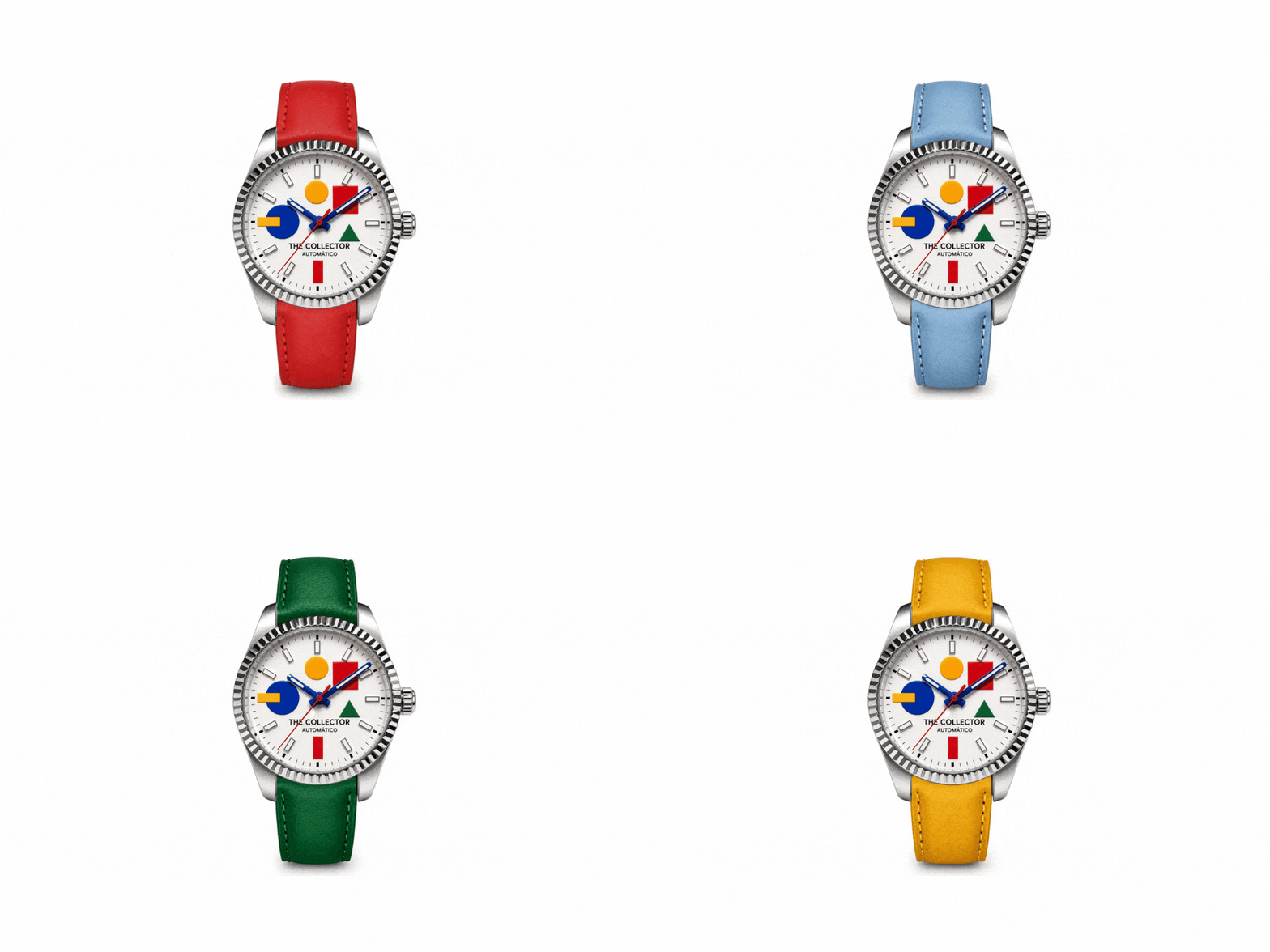
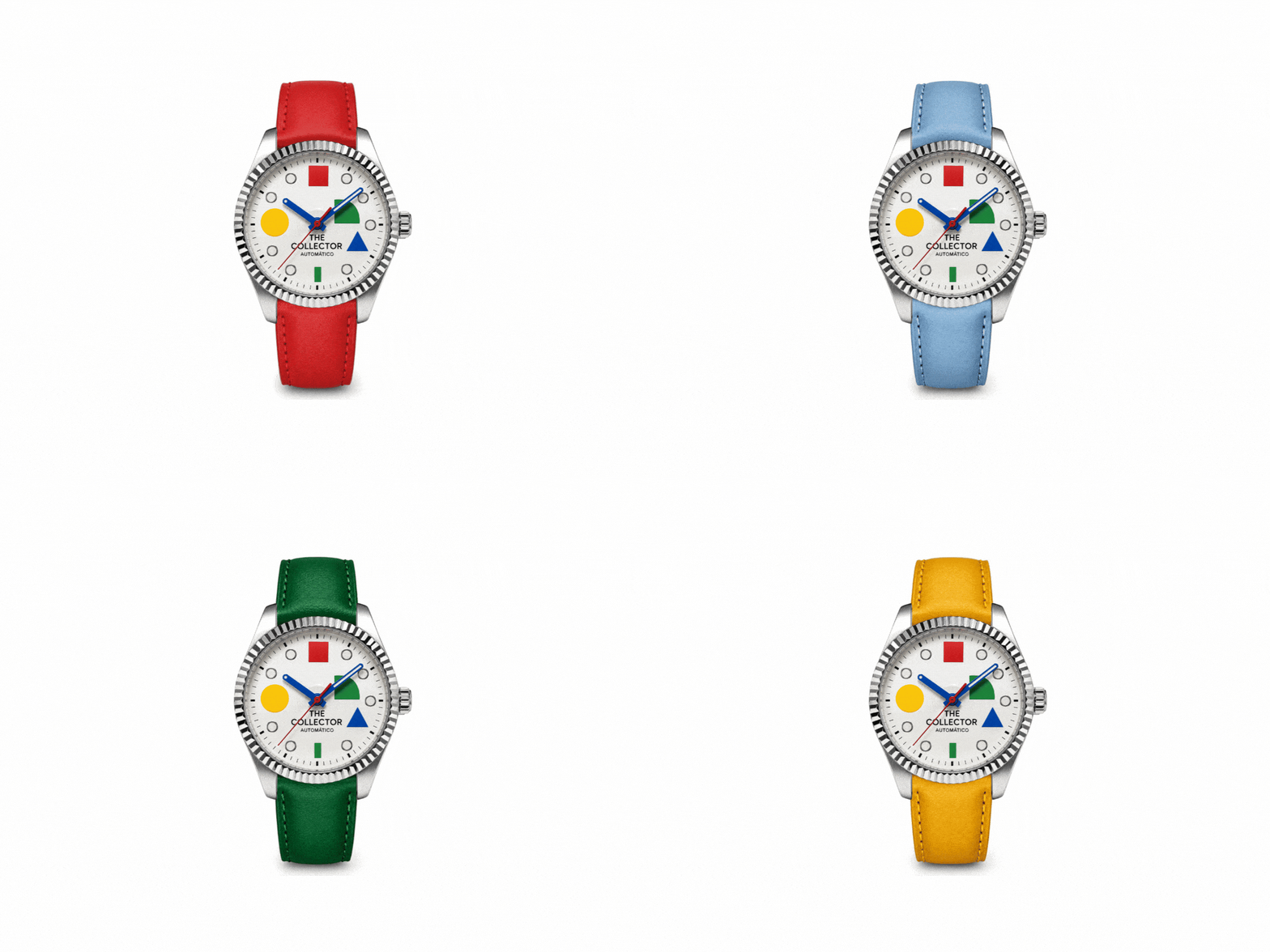
The Collector has been conceived as a collection made up of five different interpretations of time: Numbers, Roman, California, Dots and Index.
All five watches share the same case, construction and mechanical specifications. What changes is their personality: the dial and the use of color, shapes, numbers and indexes.
Backers will be able to choose their favorite The Collector skin based on the reward selected during the campaign.
Depending on the reward chosen, it will be possible to participate by purchasing a watch or one of the options of various watches and collector’s packs available during the campaign.
FROM THE CAMPAIGN TO YOUR WRIST
Once the Kickstarter campaign is successfully completed, this will be the process to take your watch from production to your wrist:
1. FINAL CHOICE
Backers will confirm their chosen The Collector model(s)—Numbers, Roman, California, Dots, or Index—along with the information needed to manage their reward.
2. PRODUCTION
Once all the choices have been collected, we will confirm the final production quantities of each of the five designs and begin series production with our production partners.
3. ASSEMBLY AND TESTING
Each watch will be assembled with its Sellita SW200-1b automatic movement and will undergo function checks, movement regulation and water-resistance tests.
4. QUALITY CONTROL
Before going into production, each finished watch will undergo a final visual and functional inspection to check the case, dial, hands, crown, movement, bracelet and clasp.
Our goal is simple: that the watch that reaches your wrist meets the same standards that we set during the development of the prototypes.
5. PACKAGING
Once approved, each watch will be placed in its Colomer Sons presentation box, accompanied by the corresponding documentation, and prepared for delivery.
6. SHIPPING
The watches will then be prepared for shipment to our Kickstarter backers around the world.
Our goal is to start sending out The Collector rewards in January 2027.
SHIPPING
Shipping costs are not included in the reward price.
Shipping will be charged separately after the campaign ends, depending on the sponsor’s destination and the applicable transportation fee.
We chose this system so that we can calculate shipping costs as accurately and fairly as possible for each destination, rather than adding a single estimated international shipping cost to all rewards.
Sponsors will be informed of the relevant shipping cost prior to delivery.
COMMUNICATING WITH OUR SPONSORS
We know that supporting a project means trusting the people behind it.
Throughout the production and delivery process we will post regular updates on Kickstarter on the progress of manufacturing, assembly, quality control, and shipments.
Should any issues arise that could affect the planned schedule, we will openly inform our sponsors and explain the steps we are taking to address them.
From our workshop to your doll, we want every sponsor to be part of The Collector’s journey.
The Collector was never intended to become a collection.
It all started during a conversation at the home of my good friend Francisco Bernaldo, a passionate watch collector and probably one of the largest Swatch collectors in the world, with more than 20,000 pieces, plus an extraordinary collection of watches from both well-known and lesser-known brands.
Francisco has been collecting, studying and enjoying watches for years. He knows them extraordinarily well.
One day he asked me a question that seemed simple:
“Would you be able to create a new line of watches unlike anything we’ve seen so far?”
I was very clear about what the starting point should be.
A classic 39mm case, elegant and timeless, with proportions that will work just as well on a man’s wrist as on a woman’s.
But within that classical architecture he wanted the exact opposite of the conventional.
I wanted to Color. Joy. Optimism.
I wanted a watch that would make you smile every time you looked at your wrist.
For me, the real challenge was not to design just another watch.
It consisted of creating something capable of surprising someone who had already seen, had and studied thousands of them.
So I spent a lot of time thinking about one question:
What kind of watch can you create for someone who already has pretty much everything?
The answer ended up taking me back to the beginning of everything.
To the sphere.
To the different visual languages that watchmakers have used over generations to represent something as universal as time.
And that led me to another idea:
What if these watches could also tell a small part of the history of watchmaking?
I decided to create five different watch faces, each inspired by a different visual language that emerged throughout the evolution of the watch face:
ROMAN. NUMBERS. CALIFORNIA. INDEX. DOTS.
Together they would form a small journey through the history of watchmaking.
Not as an academic lesson, but as an invitation to watch lovers to discover how our way of visually interpreting and reading time has evolved over the years.
Then came the funniest part.
Take that story and break some of its rules.
The Roman numerals were filled with color.
The Arabic numerals took on a playful character.
Traditional indices gave way to unexpected combinations of circles, squares, and triangles.
Red, blue, yellow and green entered a world traditionally dominated by sobriety and conventions.
The idea was not to reject the watchmaking tradition.
It was playing with her.
To take recognizable elements from the history of the spheres and reinterpret them through the spirit that Francis had called for from the beginning:
Color, joy and optimism.
One idea led to another.
One sphere became two.
Then in three.
And finally, five completely different personalities emerged from the same watch.
They all share the same 39mm case, mechanical heart and construction.
But each speaks a completely different visual language.
ROMAN. Tradition reinterpreted through colour.
NUMBERS. The universal language of legibility, taken to a more playful terrain.
CALIFORNIA. Two historical languages that are in the same sphere.
INDEX. Simplicity, order and modernity.
DOTS. Time reduced to its most abstract geometric expression.
FIVE CHAPTERS. FIVE VISUAL LANGUAGES. A COLLECTION.
And when it came time to name the project, there could really only be one.
The person who inspired him had dedicated a good part of his life to collecting watches.
And now, unexpectedly, he himself had inspired a collection.
THE COLLECTOR
Created for a collector.
Made for collectors all over the world.

Five personalities. The same mechanical base.
All the watches in The Collector collection share the same case, construction and mechanical specifications. What changes is the dial: five different interpretations of time built on the same mechanical watch.
LIMITED EDITION To 250 units per model.
CASE AND DIMENSIONS
• Case diameter: 39 mm
• Thickness: 11.90 mm
• Distance between handles: 46 mm
• Width between handles: 20 mm
• Weight: 110 g
• 316L stainless steel case
• Fluted bezel
• Screw-down crown
MOVEMENT
• Sellita SW200-1b
• Swiss automatic mechanical movement
• 26 jewels
• 28,800 vibrations per hour / 4 Hz
• 41-hour power reserve
GLASS AND CASEBACK
• Front sapphire crystal
• Exposed caseback
• Mineral crystal on the caseback
WATER RESISTANCE
• 10 ATM / 100 meters
DIAL
• Five different layouts: Numbers, Roman, California, Dots, and Index
• Three-dimensional elements applied to the dial
• Specific combinations of numbers, indexes, geometric shapes and color for each model
BRACELET
• Stainless steel bracelet
• Folding clasp with push-buttons
• Width between handles: 20 mm
WARRANTY
• 10-year Colomer & Sons warranty
Designed in Spain. Powered by Swiss mechanics. Created for collectors.

The Collector isn’t just a concept. It’s a fully functional mechanical watch.
The design and development phase of The Collector has already progressed to the creation of functional prototypes.
Our prototypes allow us to evaluate the watch in real-world conditions, including the proportions of its 39 mm case, its presence on the wrist, bracelet and clasp, the screw-down crown, the dial construction and the operation of the Sellita SW200-1b automatic movement.
The video below shows one of our real functional prototypes, manipulated and put into operation by our team in a single continuous, unedited shot.
Here you can see the movement working in real time, the actuation of the hands by the crown, the threaded crown mechanism, the bracelet and the clasp, as well as the watch from different angles.
What you see here is a real, fully functional prototype, not a render.
The goal of the Kickstarter campaign is not to develop a watch from scratch. The design and prototyping phases are now complete. The campaign will allow us to bring The Collector into production and manufacture the watches for our backers.
DEVELOPMENT STATUS AND PRODUCTION SCHEDULE
The Collector is already well advanced with respect to the conceptual phase.
The design, engineering and prototyping phases are complete. We have developed functional prototypes that have allowed us to evaluate the case, dials, bracelet, movement integration, proportions and overall construction of the watch before moving into series production.
Our manufacturing partners and major components have already been selected. Once the Kickstarter campaign is successfully completed, we will move directly into the production process.
WHAT ARE WE AT
✓ Finished collection concept and design
✓ Five finished dial designs
✓ Case development and finished bracelet
✓ Selected and tested movement
✓ Manufactured functional prototypes
✓ Finished prototype evaluation
✓ Selected manufacturing partners
✓ Development of the finished packaging
PRODUCTION SCHEDULE
SEPTEMBER 2026 — Kickstarter Campaign
The Collector launches on Kickstarter. Once the campaign is over, the final production quantities will be confirmed based on the models chosen by our backers.
OCTOBER 2026 — Production preparation
Final quantities of Numbers, Roman, California, Dots and Index will be confirmed. Sellita SW200-1b components, dials, cases, bracelets and movements will enter the production and procurement process.
NOVEMBER–DECEMBER 2026 — Manufacturing, assembly and quality control
The components will be manufactured and inspected prior to assembly. The watches will then be individually assembled and checked as part of our quality control process.
JANUARY 2027 — Final Inspection, Packaging Shipping
The finished watches will undergo a final inspection and final testing before being packaged and prepared for shipment.
We aim to start shipping The Collector watches to Kickstarter backers in January 2027.
FROM WATCHES TO THE WRIST
Before the wristwatch, there were already Roman numerals.
For centuries, Roman numerals were one of the most recognizable ways of representing time in watchmaking, present on watches and pocket watches long before the watch reached the wrist.
In the early 20th century, this classical language made the leap to the then-emerging wristwatch. In 1904, Louis Cartier created the Santos for aviator Alberto Santos-Dumont, one of the first wristwatches and an enduring example of the use of Roman numerals on the wrist.
The Collector Roman reinterprets this historical language through color, geometry and a contemporary look.
THE REAL FUNCTIONAL PROTOTYPE
Below we show the real working prototype of ROMAN used during the development of The Collector.
WHEN READING THE TIME JUST GOT EASIER
As watches became more practical, their dials began to change.
Roman numerals had dominated dials for generations, but by the end of the 19th century new dial-making techniques contributed to Arabic numerals becoming more common.
Its main advantage was simple: readability.
When watches moved from the pocket to the wrist in the early 20th century, large Arabic numerals took on particular importance. During World War I, so-called trench clocks frequently used large, highly visible numerals, designed to be able to tell the time at a glance.
The Collector Numbers takes that clarity-based language and transforms it through color, scale, and contemporary geometry.
THE REAL FUNCTIONAL PROTOTYPE
Below is the actual working prototype of NUMBERS used during the development of The Collector.
WHEN TWO LANGUAGES BECAME ONE
What happens when watchmaking breaks its own rules?
In 1941, Rolex filed a patent for a rare dial that combined Roman numerals, Arabic numerals, and geometric hour markers in a single design.
Later known as the “Error-Proof” dial, the contrast between its different visual elements created a characteristic and highly legible way of reading the time. This style would also appear on historic military watches during the 1940s.
Interestingly, the name “California dial” came much later, and it began to be associated with this design decades after its creation.
The Collector California celebrates that same idea: different visual languages coming together to create something unexpected.
THE REAL FUNCTIONAL PROTOTYPE
Below is the actual working prototype of CALIFORNIA used during the development of The Collector.
LESS BECAME MORE
What happens when the numbers disappear from the dial?
In the mid-20th century, watch design began to evolve towards cleaner and increasingly modern shapes. Applied hour markers came into greater prominence during the 1950s, while simple straight and baton indexes were strongly established during the 1960s.
By eliminating numbers, watchmakers discovered that a dial could be simplified without losing its ability to indicate time. The hour index itself became both function and design.
This minimalist language would eventually become one of the most enduring codes of modern watchmaking.
The Collector Index takes this idea of simplicity and brings a new personality to it through proportions, color, and three-dimensional shapes.
THE REAL FUNCTIONAL PROTOTYPE
Below is the actual working prototype of INDEX used during the development of The Collector.
WHEN GEOMETRY BECAME TIME
What happens when the traditional language of the sphere disappears completely?
During the 20th century, modernist design progressively transformed the way watches communicated time. Influenced by movements such as the Bauhaus, designers explored simplicity, proportions, and elementary geometric shapes.
By mid-century, designers such as Max Bill brought this philosophy directly to watchmaking, reducing the dial to its essential visual elements.
The Collector Dots takes this evolution a step further.
Numbers disappear. Traditional indices disappear. Circles, squares, triangles and colors become the language through which time is read.
Here, geometry becomes time.
THE REAL FUNCTIONAL PROTOTYPE
Below is the actual working prototype of DOTS used during the development of The Collector.
HOW WE WILL USE THE FUNDS
The Collector has already been designed, developed and taken to the prototype stage.
The development and creation phases of the functional prototypes have been funded by Colomer Sons. This means that the funds raised through Kickstarter will mainly go towards putting the collection into production and manufacturing the watches chosen by our backers.
Based on our current production costs, this is our estimated distribution:
56 % — Manufacture of watches and components
Production of the watches, including the Sellita SW200-1b automatic movements, 316L stainless steel cases and bracelets, applied dials and elements, hands, sapphire crystals and the rest of the watch’s components.
12% — Assembly, testing and quality control
Assembly, movement regulation, leak tests and individual quality control before shipment.
8% — Packaging and preparation
Presentation cases, documentation and protective materials necessary to prepare each watch for delivery.
8% — Kickstarter fees and payment processing
Platform and payment processing costs associated with the campaign.
6% — Production and operational logistics
Transport of components, coordination of production and logistics necessary until the clocks are completed.
10% — Contingency Reserve
A reserve for possible unexpected increases in component, manufacturing or logistics costs, as well as other unforeseen production expenses.
100% — Intended to take The Collector from working prototype to production.
The development and creation phases of the functional prototypes have been financed by Colomer Sons.
REWARDS AND DELIVERY
Choose your personality. Or collect them all.
The Collector has been conceived as a collection made up of five different interpretations of time: Numbers, Roman, California, Dots and Index.
All five watches share the same case, construction and mechanical specifications. What changes is their personality: the dial and the use of color, shapes, numbers and indexes.
Backers will be able to choose their favorite The Collector skin based on the reward selected during the campaign.
Depending on the reward chosen, it will be possible to participate by purchasing a watch or one of the options of various watches and collector’s packs available during the campaign.
FROM THE CAMPAIGN TO YOUR WRIST
Once the Kickstarter campaign is successfully completed, this will be the process to take your watch from production to your wrist:
1. FINAL CHOICE
Backers will confirm their chosen The Collector model(s)—Numbers, Roman, California, Dots, or Index—along with the information needed to manage their reward.
2. PRODUCTION
Once all the choices have been collected, we will confirm the final production quantities of each of the five designs and begin series production with our production partners.
3. ASSEMBLY AND TESTING
Each watch will be assembled with its Sellita SW200-1b automatic movement and will undergo function checks, movement regulation and water-resistance tests.
4. QUALITY CONTROL
Before going into production, each finished watch will undergo a final visual and functional inspection to check the case, dial, hands, crown, movement, bracelet and clasp.
Our goal is simple: that the watch that reaches your wrist meets the same standards that we set during the development of the prototypes.
5. PACKAGING
Once approved, each watch will be placed in its Colomer Sons presentation box, accompanied by the corresponding documentation, and prepared for delivery.
6. SHIPPING
The watches will then be prepared for shipment to our Kickstarter backers around the world.
Our goal is to start sending out The Collector rewards in January 2027.
SHIPPING
Shipping costs are not included in the reward price.
Shipping will be charged separately after the campaign ends, depending on the sponsor’s destination and the applicable transportation fee.
We chose this system so that we can calculate shipping costs as accurately and fairly as possible for each destination, rather than adding a single estimated international shipping cost to all rewards.
Sponsors will be informed of the relevant shipping cost prior to delivery.
COMMUNICATING WITH OUR SPONSORS
We know that supporting a project means trusting the people behind it.
Throughout the production and delivery process we will post regular updates on Kickstarter on the progress of manufacturing, assembly, quality control, and shipments.
Should any issues arise that could affect the planned schedule, we will openly inform our sponsors and explain the steps we are taking to address them.
From our workshop to your doll, we want every sponsor to be part of The Collector’s journey.
BUSINESS WATCHES
ACCEPTED PAYMENTS

Interest-free financing (+info)
CUSTOMER AREA
My account
Frequently asked questions
Subscribe to our newsletter

© 2026 Colomer Sons. All rights reserved.